
“Have you accepted our Lord and Saviour, Generative AI, into your workflow yet?”. That thought has been running through my head repeatedly after attending the APMP ANZ Bid Winning Conference in Melbourne. Not because I am anti AI, quite the opposite.
I use AI software regularly myself across research, synthesis, structuring, brainstorming, workflow acceleration and challenging my own thinking. At times it feels less like software and more like a brutally honest mirror with internet access. The value is real, and the impact it will have on our profession is equally real.
What I find particularly interesting is the drift of conversations toward AI as a strategy itself, rather than a tool that supports strategy. That drift is not isolated to bids or proposal management either. It’s a conversation that’s trending across multiple industries at the moment. There is a growing tendency to talk about AI adoption as though deploying the technology automatically creates competitive advantage, strategic clarity or better decision making.
In reality, AI is still a tool, an incredibly powerful tool, although still a tool. The organisations seeing the strongest outcomes are usually the ones combining AI with strong governance, critical thinking, commercial reasoning and clear strategic intent. Generative AI technology amplifies capability. It does not replace the need for capability itself.
Several sessions across the conference reinforced that point from different angles. One of the strongest sessions for me was the discussion around Thinking, Fast and Slow and how humans naturally substitute difficult questions with easier ones. That observation feels incredibly relevant to the current AI conversation.
A lot of organisations seem deeply focused on how fast content can be generated, how many workflows can be automated, how many tools can be deployed, and how sophisticated the technology stack looks. Fewer conversations seem focused on whether organisations are actually improving on:
• Strategic thinking
• Decision making
• Positioning
• Client understanding
• Pursuit quality, or
• Commercial clarity.
Successful bid leadership was never based on simply producing more content, faster. It has always been about clarity. Clarity of thinking, clarity of value, clarity of positioning and clarity of decision making.
Social procurement discussions reinforced something similar. Procurement environments are becoming increasingly sophisticated in governance, ESG expectations, evaluation frameworks and measurable impact requirements. Clients are looking for mature thinking, integrated strategy and genuine outcomes rather than generic statements and superficial compliance language.
The AI discussions reinforced another important reality, technology can absolutely improve workflows, accelerate analysis and remove low value administrative effort, but technology alone does not automatically improve thinking.
Computers entering workplaces in the 1980s followed a very similar cycle. Businesses were told computers would revolutionise productivity, eliminate inefficiency and fundamentally reshape work almost overnight. A few years later, many organisations were still trying to work out why they suddenly had more systems, more process complexity and somebody named Gary printing every email for “the file”.
The introduction of computers into homes throughout the late 1980s and 1990s followed a similar path, there was excitement, confusion, inflated expectations and no shortage of people confidently claiming the internet would either save civilisation or destroy it entirely.
Estimation software like Expert fundamentally changed the way projects were priced and delivered. Adobe Creative Suite transformed the way graphic designers and creative professionals produced work. Cloud systems and automation followed similar patterns as organisations adapted workflows, processes and roles around new technology.
The common theme across every major technology shift is that the technology itself is rarely the final answer. There is usually a period of excitement, fear, inflated expectations, operational disruption, disillusionment and eventual process redesign before the technology settles into normal business practice. AI feels very similar to me.
A lot of organisations are discovering that AI does not magically remove operational complexity. In many cases it introduces entirely new forms of it, including:
• Governance issues
• Poor data quality
• Review fatigue
• Version control problems
• Compliance risks
• More outputs to validate
• More content to assess, and
• More noise to filter through.
Some teams are learning that generating 40 pages in 10 minutes is not particularly useful if nobody stopped to ask whether the response actually answers the client’s problem, aligns to the strategy or differentiates the solution.
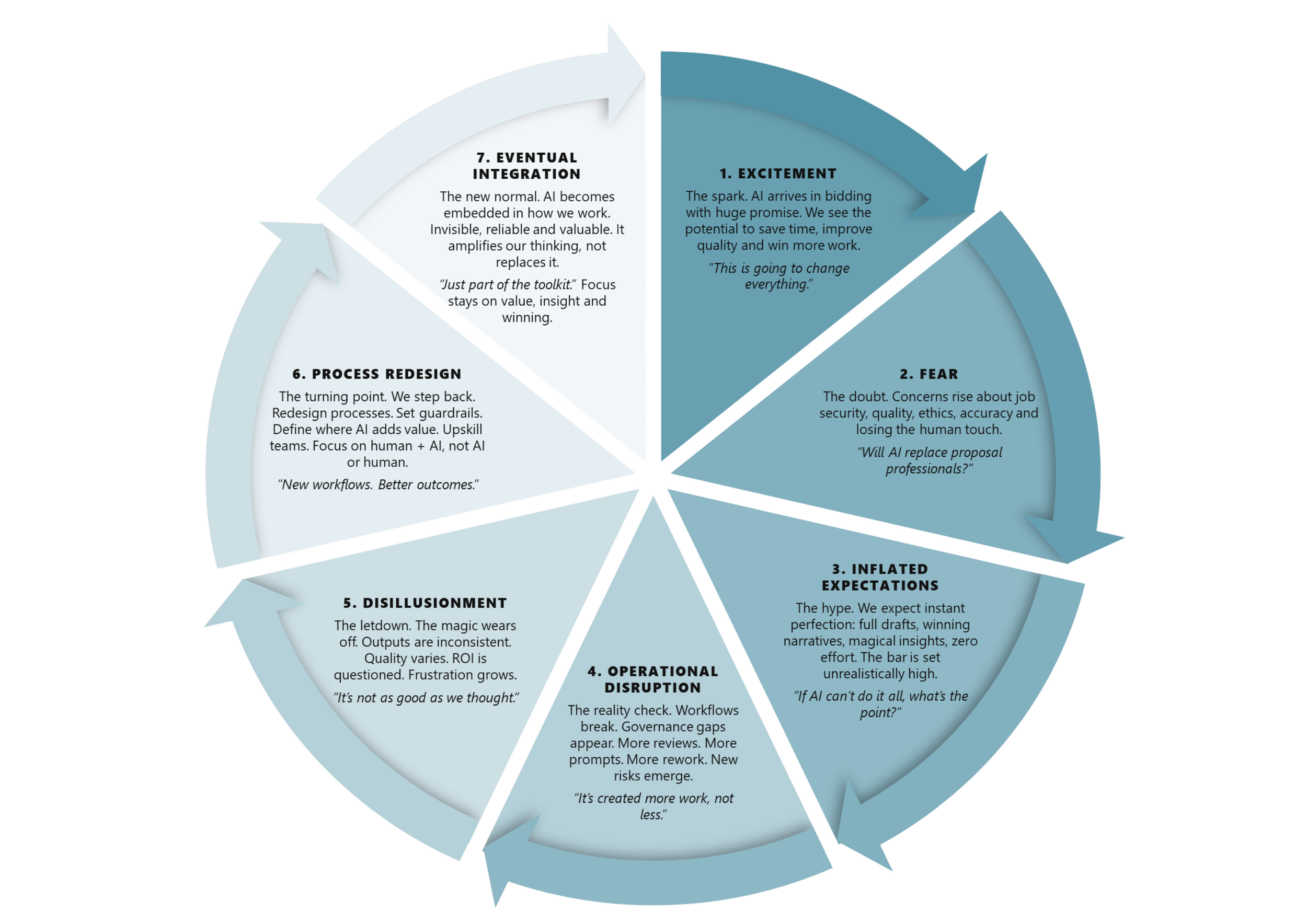
Figure 1: Major technology revolution and organisational realities applied to bids, tenders and procurement
One of the strongest underlying themes across the conference was that increasingly sophisticated tools, frameworks and workflows still rely on deeply human capabilities. Ironically, the more AI advances, the more valuable those skills become.
J u d g e m e n t .
C o m m u n i c a t i o n .
C o m m e r c i a l r e a s o n i n g .
E m p a t h y .
T r u s t .
R e l a t i o n s h i p b u i l d i n g .
U n d e r s t a n d i n g c o n t e x t .
From my experience, the teams and organisations genuinely pulling ahead are not replacing humans with AI. They are removing low value friction so people can spend more time on strategic thinking, positioning, storytelling, stakeholder engagement and making smarter pursuit decisions. That feels like the real lesson emerging right now.
Generative AI absolutely belongs in modern bid and proposal workflows. Ignoring it entirely would be like refusing to adopt cloud collaboration tools like SharePoint or digital estimating platforms. Treating it like a mystical cure-all for weak process, poor strategy or lack of leadership though, probably ends the same way most technology hype cycles eventually do.
…Right after the sermon, and somebody still has to do the actual work.
Brittany Walker Principal Consultant, Bids and Director | MBD & Co Pty Ltd
Britt is a bid strategist specialising in complex infrastructure, engineering, mining and professional services pursuits across Australia. With a background spanning proposal strategy, persuasive writing, procurement, commercial positioning and client engagement, Britt works with organisations to improve clarity of thinking, strengthen strategic positioning and develop high quality submission responses in increasingly complex procurement environments. She is also professionally committed to challenging assumptions, simplifying complexity and occasionally questioning whether industry has confused software adoption with actual strategy.